

The content on our website is provided solely for general informational purposes.  It should not be considered, nor is it intended to provide advice or recommendations for the purchase, sale, or trade of any products or services.  Importantly, the information presented does not constitute an offer to sell or a solicitation of an offer to buy any product.

Please be aware that the availability of our products may vary across different markets due to regulatory restrictions or other considerations. Consequently, not all products or services may be available in your region or country. For specific inquiries regarding the availability and pricing of any product, please contact us at sales@noctiluca.eu.

Basic Info

Cas number: 117901-97-0
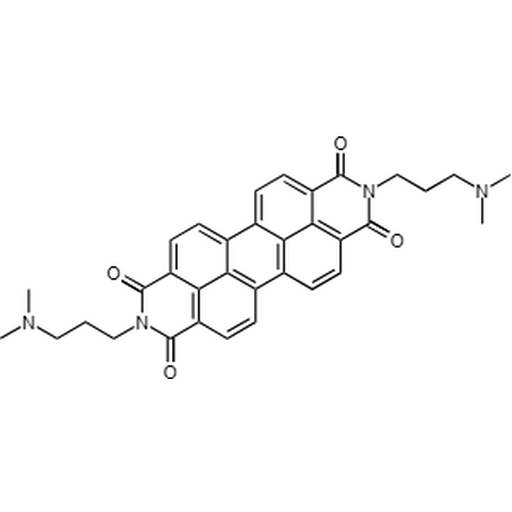
Chemical Formula: C34H32N4O4
Purity: 98% (1H NMR)
Synonyms: PDI-N, DAPER, DAPER DNA precipitation reagent, 2,9-Bis[3-(dimethylamino)propyl]anthra[2,1,9-def:6,5,10-d'e'f']diisoquinoline-1,3,8,10(2H,9H)-tetrone

Properties

Name: PDIN
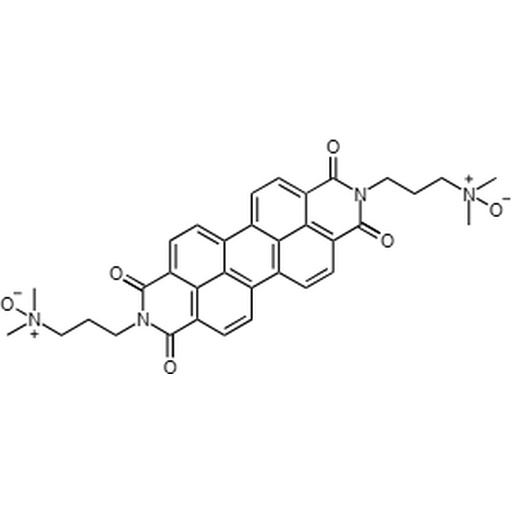
Full Name: N,N'-Bis[3-(dimethylamino)propyl]perylene-3,4,9,10-tetracarboxylic diimide
Appearance: Red powder/crystals
Application for devices: ETL, HBL
Classification: Electron transport layer materials (ETL), Organic semiconducting materials, Small molecule electrolyte, Cathode interlayer materials
Homo Lumo: HOMO = -6.1 eV, LUMO = -3.7 eV
Melting Point: DSC: >300 °C
Purification Techniques: Chromatography
Transport Layers: Electron Transport Layer (ETL), Hole Blocking Layer (HBL)
Use by function: Photonic Materials, Optical Materials

Optical properties

Absorption: λmax = 480 nm in film, λmax = 527 nm in DMSO
Fluorescence: N/A

Compound Description

PDIN: A Pioneering Material in Organic Electronics

The field of organic electronics is continually advancing, and materials like PDIN are at the forefront of this progression. Recognized for its electron-transporting capabilities and its role as a cathode interlayer material, PDIN exemplifies the innovations in the organic electronics sector.

Understanding PDIN

N,N’-Bis[3-(dimethylamino)propyl]perylene-3,4,9,10-tetracarboxylic diimide, commonly known as PDIN, is characterized by its unique molecular configuration. It consists of an amino group (N) on perylenediimide (PDI), which is integral to its electron-transporting properties.

Key Features of PDIN

  • Electron Transporting Layer (ETL) Material: PDIN’s inherent properties make it an ideal electron transporting layer material, enhancing surface morphology in optoelectronic devices.
  • Cathode Interlayer for Polymer Solar Cells: Its role as a cathode interlayer material has shown significant improvements in the performance of polymer solar cells.
  • DAPER DNA Precipitation Reagent: At extremely low concentrations, PDIN is also known as DAPER, a DNA precipitation reagent, showcasing its versatility in various applications.

The Role of PDIN in Advanced Organic Electronics

PDIN’s electron-deficient nature, combined with its π-electron structure, positions it as a standout material in the organic electronics domain. This unique combination ensures efficient electron transport, which is crucial for the performance of optoelectronic devices. Furthermore, PDIN’s molecular structure promotes stable interactions with other organic materials, leading to enhanced device longevity and efficiency.
Its compatibility extends beyond just its molecular interactions. PDIN showcases remarkable adaptability with various metals, including Al, Au, and Ag. This metal compatibility is not just a mere attribute but a significant advantage. When used in devices like organic solar cells, this compatibility ensures optimal electron injection and extraction, leading to improved device performance. Additionally, the synergy between PDIN and these metals can lead to enhanced stability, reduced energy barriers, and improved charge transport – all of which are critical for the overall performance of organic electronic devices.
Bibliography

Perylene diimides: a thickness-insensitive cathode interlayer for high performance polymer solar cells, Z. Zhang et al., Environ. Sci., 7, 1966 (2014); DOI: 10.1039/c4ee00022f. N,N'-bis[3,3'-(dimethylamino)propylamine]-3,4,9, 10-perylenetetracarboxylic Diimide, a Dicationic Perylene Dye for Rapid Precipitation and Quantitation of Trace Amounts of DNA, Z. Liu et al., Anal. Biochem, 5; 236(1):139-45 (1996); DOI: 10.1006/abio.1996.0142. A non-fullerene small molecule processed with green solvent as an electron transporting material for high efficiency p-i-n perovskite solar cells, J. Miao et al., Org. Electonics, 52, 200-205 (2018); DOI: 10.1016/j.orgel.2017.10.028

Featured Compounds

Have any questions? Feel free to contact us!

Prefer a meeting? Schedule a date

Want to send a message? Fill out the form