PPT >99% – High-Purity ETL and Host Material for OLED Applications
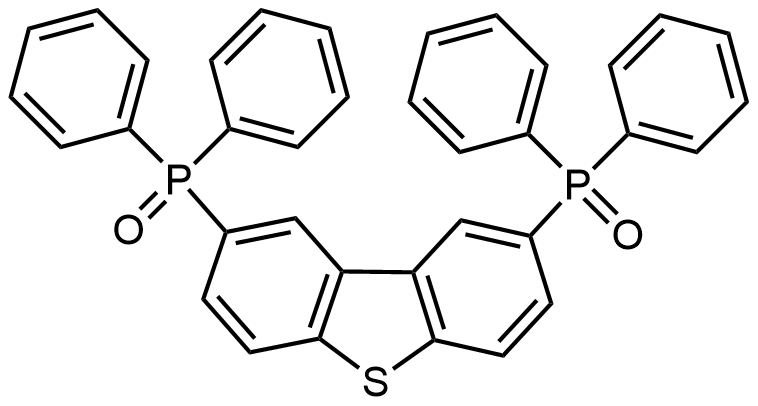
Noctiluca proudly offers PPT, a high-purity (>99% HPLC) compound essential for advanced organic light-emitting diode (OLED) applications. Formally known as 2,8-Bis(diphenyl-phosphoryl)-dibenzo[b,d]thiophene, with the molecular formula C₃₆H₂₆O₂P₂S and CAS number 1019842-99-9, PPT is meticulously synthesized to meet the rigorous demands of modern optoelectronic technologies. Recognized as a premium electron transport layer (ETL) material and host compound, PPT delivers exceptional thermal stability, superior photoluminescent properties, and efficient charge transport capabilities. These attributes make PPT indispensable for cutting-edge OLED innovations, including TADF and organic persistent luminescence applications.
Molecular Structure and Properties of PPT
PPT is an organic compound with a molecular weight of 584.60 g/mol, available as a yellow powder. It exhibits dual absorption maxima (λₘₐₓ) at 312 nm and 328 nm in dichloromethane (DCM) and a photoluminescent emission peak (λₘₐₓ) at 350 nm. The compound’s HOMO level of 6.7 eV and LUMO level of 3.0 eV ensure optimal energy alignment for efficient charge transport and energy transfer, making it highly suitable for use in OLED devices demanding high performance and stability.
Key Features of PPT
- Exceptional Purity and Quality: Noctiluca’s PPT is purified through a rigorous sublimation process and high-performance liquid chromatography (HPLC), ensuring a purity level exceeding 99%. This guarantees reliable performance and consistent results in OLED applications where material purity is critical for device efficiency and longevity.
- Optimized for ETL and Host Applications: PPT is engineered to enhance electron transport and energy transfer in OLED devices. Its HOMO/LUMO alignment supports efficient charge balance, improving light emission stability and overall device performance.
- Thermal Stability and Longevity: PT exhibits robust thermal stability, with a decomposition temperature (Td) threshold exceeding 320 °C (as indicated by TGA). This resilience ensures that devices using PPT maintain structural and functional integrity under demanding operating conditions, contributing to extended device lifetimes.
- Versatile Processing Capabilities: PPT is compatible with multiple fabrication methods, including vacuum deposition and solution processing. Its adaptability supports both experimental research and large-scale industrial production, broadening its application in advanced optoelectronic devices.
The Role of PPT in Advanced OLED Technologies
PPT plays a vital role in OLED device optimization, particularly as an electron transport layer and host material. Its molecular structure supports efficient charge transport and balanced energy transfer, enhancing the brightness, energy efficiency, and operational stability of OLEDs. Additionally, its compatibility with TADF technologies and organic persistent luminescence makes PPT a valuable material for next-generation display and lighting applications, where high performance and long-term reliability are essential.
Conclusion
Noctiluca’s PPT >99% exemplifies our dedication to delivering high-purity materials tailored to meet the demands of advanced OLED and optoelectronic applications. With its exceptional thermal stability, photoluminescent efficiency, and versatile processing capabilities, PPT enables researchers and manufacturers to push the boundaries of OLED technology. Discover PPT’s potential for your optoelectronic projects and explore how Noctiluca’s materials drive innovations in display and lighting solutions.