

The content on our website is provided solely for general informational purposes.  It should not be considered, nor is it intended to provide advice or recommendations for the purchase, sale, or trade of any products or services.  Importantly, the information presented does not constitute an offer to sell or a solicitation of an offer to buy any product.

Please be aware that the availability of our products may vary across different markets due to regulatory restrictions or other considerations. Consequently, not all products or services may be available in your region or country. For specific inquiries regarding the availability and pricing of any product, please contact us at sales@noctiluca.eu.

Basic Info

Cas number: 921205-03-0
Chemical Formula: C39H27N3
Purity: Sublimed: >99%
Synonyms: Tm3PyPB, 1,3,5-Tris(3-pyridyl-3-phenyl)benzene, 1,3,5-Tri(m-pyridin-3-ylphenyl)benzene

Properties

Name: TmPyPB
Full Name: 1,3,5-Tri[(3-pyridyl)-phen-3-yl]benzene
Appearance: White powder/crystals
Application for devices: Host, ETL, HBL
Classification: Organic light-emitting diodes, TADF materials, Host materials, Emmiting layer materials (EML), Electron transport layer materials (ETL), PHOLED materials, Hole blocking layer materials (HBL), Perovskite solar cells, Organic photovoltaics (OPV), Solution-processed OLED materials
Homo Lumo: HOMO = 6.8 eV, LUMO = 2.8 eV
Host Materials: Fluorescent
Melting Point: 195 - 200 °C
Purification Techniques: Sublimed Materials
TADF Materials: Other TADF materials
Transport Layers: Electron Transport Layer (ETL), Hole Blocking Layer (HBL)
Use by function: OLED Materials, TADF Materials, Perovskite Materials, DSSC Materials

Optical properties

Absorption: λmax = 254 nm in DCM
Fluorescence: λmax = 353 nm in DCM

Compound Description

TmPyPB: Elevating OLED Technology with High-Performance Materials

The relentless advancement in organic electronics has been significantly attributed to innovative materials like TmPyPB. This compound is swiftly becoming indispensable in the industry, particularly within the sphere of organic light-emitting diodes (OLEDs).

Understanding TmPyPB

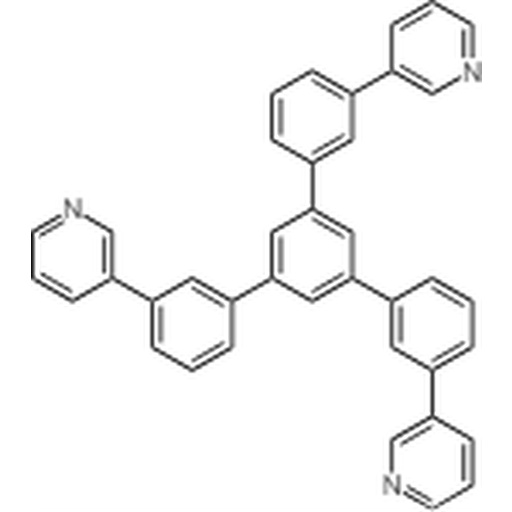
TmPyPB, known scientifically as 1,3,5-Tris(3-pyridyl-3-phenyl)benzene, is a compound with a complex molecular structure that is vital for the development of OLED technology. It consists of a central benzene ring substituted with three pyridylphenyl groups, which imparts distinctive electronic properties to the molecule.

Key Features of TmPyPB

TmPyPB’s molecular design translates into several key features that make it a valuable asset in OLED manufacturing:

  • Electron Transport Layer (ETL) Material: TmPyPB’s structure facilitates efficient electron transport, which is crucial for the operation of OLEDs.
  • Hole Blocking Layer (HBL) Material: It also serves as an effective hole blocking layer, preventing the recombination of electrons and holes in undesired areas of the device.
  • Luminescent Properties: The compound’s ability to emit strong blue light is leveraged in the emitting layers of OLEDs, contributing to the vivid displays of modern electronic devices.

The Versatility of TmPyPB in Material Science

TmPyPB’s applications extend beyond OLEDs. Its luminescent properties and structural versatility make it a candidate for use in other areas of material science, such as:

  • Sensing Technologies: Its ability to act as a fluorescent probe is explored in the detection of metal ions and organic compounds.
  • Novel Luminescent Materials: Researchers are investigating TmPyPB for developing new luminescent materials with potential applications in various fields of technology.

Conclusion

TmPyPB is not just enhancing the current generation of OLEDs; it is paving the way for future innovations in organic electronics. With its high purity, multifunctional applications, and strong blue emission, TmPyPB is set to become a cornerstone in the evolution of electronic materials.
Bibliography

Shi-Jian Su, Takayuki Chiba, Takashi Takeda, Junji Kido, “Pyridine-Containing Triphenylbenzene Derivatives with High Electron Mobility for Highly Efficient Phosphorescent OLEDs”, Advanced Materials, 2008, 20, 2125–2130.

Featured Compounds

Have any questions? Feel free to contact us!

Prefer a meeting? Schedule a date

Want to send a message? Fill out the form